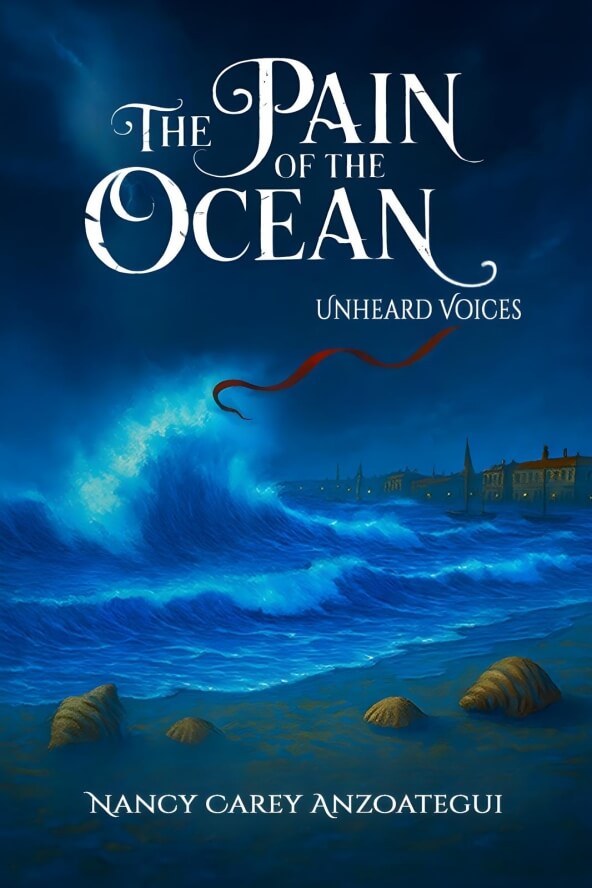
The pain of the ocean: unheard voices
De la Biblioteca de Nancy Carey Anzoategui
Detalles y Resumen
- Autora: Nancy Carey Anzoategui
- Idioma: Inglés
- Ediciónes: Kindle y Tapa Dura
- Amazon USA
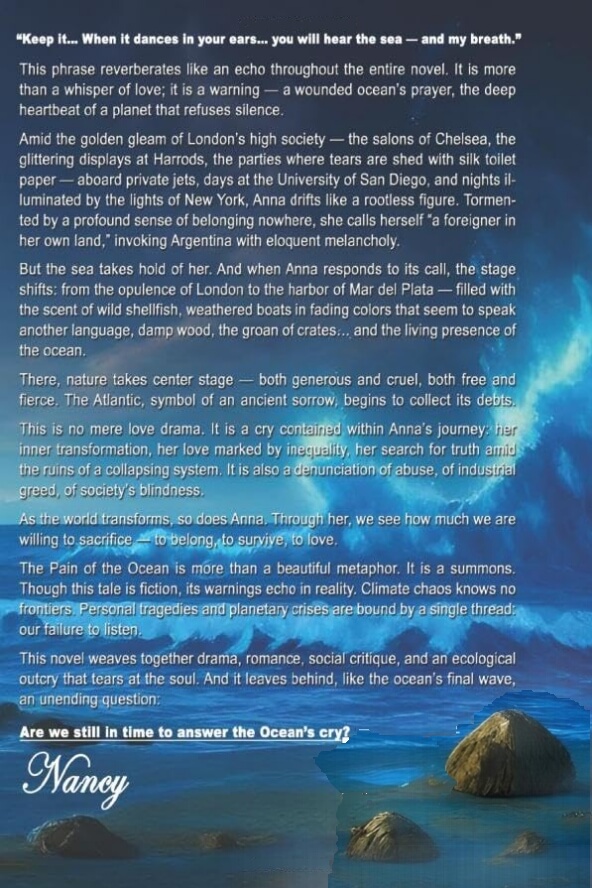
"When it dances in your ears, you will hear the sea and my breath."
That phrase reverberates like an echo throughout this novel. It is
not merely a whisper of love; it is a warning a wounded ocean'sprayer,
the deep heartbeat of a planet that refuses silence.
There, nature takes center stage both generous and cruel, both free
and fierce. The Atlantic, symbol of an ancient sorrow, begins to collect
its debts.
This is no mere love drama. It is a cry contained within Anna's journey: her inner transformation, her love marked by inequality, hersearch for truth amid the ruins of a collapsing system. It is also a denunciation of abuse, industrial greed, and society’s blindness. Every gesture of the young woman, from a glance at the horizon to a choice that changes everything, shows us there are no easy solutions and that is what makes this story so honest.
This novel is also the story of a planet in crisis a life lived among crystal and lights, in a world of perfect appearances, wherethe excess of a consuming elite finds its counterpoint in the ocean and in the consequences of ocean warming.
The first voice rises on the beaches of Mar del Plata. It belonged to no one, or perhaps to all: it was the Earth's cry. A cry longawaiting to be heard. A call that hurts, because it pleads to be listened to.
Anna discovers that her fragility is not so different from that of the sea around her. Ocean warming becomes a symbol of emotionaland spiritual imbalance, mirrored in her love of light and shadow, of distance and catastrophe. And just as the planet overheats and becomes sick, so too do our relationships, our cities, and our vision of the future.
Ocean warming is no passing phenomenon. It is the backdrop of every decision, the echo that pulses through the lives of these characters. Each time the sea breathes, rages, or falls silent, it carries a message: we stand at the threshold of no return.
The waters grow warmer, and with them, everything we once knew begins to change.
In these pages, the reader will see that ocean warming is not merely a scientific datum, but a burning call, as intense as human passions. The Atlantic, increasingly hostile and altered, mirrors both the climate crisis and Anna's transformation. The novel insists:ocean warming is an open wound that crosses borders and spares no class. Each episode reveals how the brutal change of the watersis also a reflection of the changes in our lives: a mirror of what we have done and what we may still choose.
As the story unfolds, ocean warming ceases to be a distant threat.
It becomes the very skin of the tale, the breath of humanity. Everywave,
every decision, every loss bears its mark. And yet there is beauty still.
There is still possibility.
In the end, the Pain of the ocean is more than a beautiful metaphor.
It is a summons. Though this tale is fiction, its warnings echoin reality.
The novel reminds us that ocean warming does not wait. That love links
not only people, but causes.
And that there is still time, if only we choose not to turn away.
It is an invitation. To listen. To act. To feel.
It is an invitation to read this book and to become the protagonist
of a real story. The ocean speaks. Anna heard it. Now it is the reader's
turn.